WORLD CURRENCY GES
The article presents a concept for creating a world currency GES (Grain Equivalent Standard), based on the International Monetary Fund’s reserve asset (SDR), with its nominal value pegged to the global market price of a benchmark commodity the IGC (International Grains Council).
The current crisis of global finance is prompting the world community to search for ways to reform it. The focus is on the issue of building a qualitatively new international monetary system. In the context of this problem, the paper presents a project to create a world currency GES (Grain Equivalent Standard) based on the International Monetary Fund’s reserve asset SDR with the newly created currency tied to the value of the IGC (International Grains Council) standard commodity according to the Keynesian idea of the “standard value of a composite commodity” as the value basis of the monetary unit. Since the movement of the IGC grain market value follows the trend of the long-term value movement of the bulk of commodity products on the world market, the new monetary system involves, in fact, for the GES currency to be tied to the general price trend of the world economy, which guarantees its stability in terms of purchasing power. According to the project, the SDR money supply increased to the level of the total monetary base of national currencies in the world in dollar equivalent (currently $8.27 trillion) is distributed among countries based on the quota principle according to the size of their populations and is introduced into global market circulation. Having become an international money supply, the SDR is formatted by the world market, which is to determine the nominal value of the supranational currency. As soon as the true price of the IGC grain standard in this currency is revealed, the supranational monetary unit, renamed GES, is tied to the market value of the IGC grain standard weight and drifts with it in line with the long-term price trend of the global economy. This will ensure the stability of the currency in terms of its purchasing power in the long run, a guarantee of the stability of world finance. The GES world currency is completely autonomous (independent of the monetary policy of individual countries), is used as reference exchange rate for national currencies – acting as a benchmark monetary unit, and serves as a full-fledged means of monetary circulation in the global economy.
Keywords: world monetary system, supranational currency, world currency unit.
Introduction
The concept of a supranational currency is not new. Historically, there have been two main approaches to creating such a currency (specifically as a supranational entity, rather than a national currency holding global status):
1. The Keynesian concept of a gold-currency standard, in which a supranational currency — the "Bancor" — would be pegged to a fixed gold value (essentially, its weight), while national currency exchange rates would be anchored to the Bancor itself. Although never implemented as a supranational currency, this idea was mirrored by the gold-dollar standard based on the US national currency, which had attained global status.
2. A proposal for an international unit of account (or reserve asset) based on floating national exchange rates. This artificial monetary unit — which lacks its own monetary base and does not circulate freely in the global economy — was implemented by the International Monetary Fund as Special Drawing Rights (SDRs).
Other versions of a global currency have, to varying degrees, served as supplements to or evolutions of these two approaches. Current proposals seeking alternatives to dollar dominance focus precisely on these models.
What is unique about the proprietary GES supranational currency project, and how does it differ from the others mentioned? It is based on a fundamentally different philosophy of money. All existing versions of both national and global currencies — from the Fisher equation (MV = PQ) to the New Keynesian IS-LM model, which underpin the modern macroeconomic mainstream — treat money in isolation from the real economy. Under this conventional approach, financial institutions pre-calculate the value parameters of the monetary unit, issue a planned volume of money, and regulate circulation primarily by manipulating interest rates. In contrast, this proprietary approach views money as an integral component of the economy itself — as the embodiment of value — organically "woven" into the cycle of living and materialized labor within the market space. Consequently, the value parameters of the monetary unit and the money supply are determined by the economy itself. The role of financial institutions is merely to inject a specific quantity of monetary media — whether metal, paper, or electronic — into the economy. The actual process of goods-money circulation performs the function of shaping the money supply, thereby determining the price scale of the monetary unit and, consequently, its nominal value.
This proposed reform of the global monetary system advocates using the SDR reserve asset — with its issuance volume expanded to match the aggregate global monetary base of national currencies (in dollar terms) — to establish a full-fledged supranational currency. This new currency would be pegged to the market value of the IGC (International Grains Council) grain benchmark, aligning it with the global economy's long-term price trend. The proposal is highly realistic: at its inception, the global currency would rest on the solid foundation of the established SDR asset, while its long-term value would be anchored to the price trend of a tangible commodity — the IGC grain benchmark. This approach would instill confidence in the currency's long-term purchasing power stability, thereby ensuring the stability of the global financial system.
The aim of the article is to develop an algorithm for creating the supranational currency GES based on the SDR reserve asset, with its nominal value pegged to the market price of the IGC benchmark commodity, thereby ensuring the purchasing power stability of the supranational monetary unit and serving as a guarantee of stability for the global monetary system as a whole.
The research methodology is based on the conceptual principles of the labor theory of value found in classical political economy. These principles established the labor-intensive nature of value-exchange processes in a market economy as the foundation of monetary circulation: money serves as a symbolic expression of value, which, in turn, represents the market-assessed labor intensity of goods.
Since the economy itself shapes any monetary system, it is essential to examine its fundamental nature thoroughly; without a proper understanding of the economy, one cannot grasp the true function of monetary instruments in exchange processes within the context of an integrated economic system. Let us begin, then, with the question: what is an economy?
Macroeconomic model of the circulation of labor and money
The economy is, first and foremost, the circulation of living and materialized labor within society, utilizing a monetary equivalent of labor inputs during processes of value exchange. A macroeconomic model based on this approach (Fig. 1) posits the existence of a producer society and a consumer society (essentially the same people, merely acting in different capacities), as well as two reciprocal flows between economic agents: a labor-related flow (comprising living labor in production and materialized labor in market products) and a monetary flow. Furthermore, in the case of expanded reproduction, a distinct monetary flow emerges: an investment flow from economic agents to the production sector aimed at mobilizing additional labor resources.
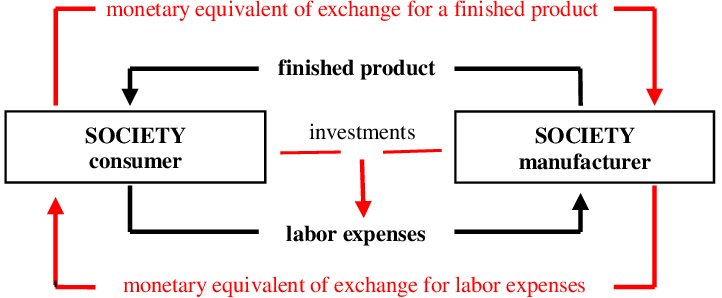
of living-embodied labor and monetary flows in a market economy.
Source: created by the author.
The fundamental essence — the core — of the economy lies in the cycle of living and objectified labor, facilitated by monetary exchange mechanisms. The rationale behind this cycle stems from society’s struggle for survival within its environment. To survive, people must create material goods for consumption; in turn, consuming these goods restores the capacity to work, enabling the continued production of material goods.
In a market economy, the labor cycle is accompanied by two exchange processes. The first process represents the remuneration of living labor costs with part of the manufactured product in monetary equivalent at the production stage, presupposes the existence of a labor market. The second process represents the exchange of labor results in the form of manufactured products with the mediation of the monetary equivalent at the stage of consumption, presupposes the existence of a goods market. The exchange processes involving living and objectified labor — spanning production and consumption — rely on monetary instruments: money serves as the medium for exchanging living labor in the labor market and objectified labor in the product market. Flows of living and objectified labor move in one direction, while monetary flows move in the opposite direction. This constitutes a synchronous, counter-directional movement — a simultaneous counter-circulation — of labor and money. What, then, is money?
In the era of subsistence production, sporadic exchanges between economic agents took the form of equivalent swaps of the fruits of labor, relying on a mental valuation of the labor embodied in the products. However, as small-scale goods production superseded subsistence production, it became apparent that mental valuations were insufficient for handling the growing volume of embodied labor in mass goods exchange; the human mind could not keep track of the ever-increasing array of value assessments. This created a need for physical media to represent market valuations of labor input — media serving as a universal equivalent for labor expenditure. By encoding these labor-value equivalents onto specific media (such as metal, paper, etc.), humanity created money. Thus, money is not merely a specialized goods for exchange and payment, as is commonly believed; rather, it is a symbolic representation — carried on specific media — of the labor intensity (i.e., value) of goods and services as established by the market. Consequently, banknotes serve as a nominal equivalent of real value — or, simply put, as a symbolic expression of value. On an economy-wide scale, the money supply represents the aggregate value of material goods within that economy.
The primary function of money is to ensure the optimal circulation of living and objectified labor inputs within the economy. This is an objective function that is not perceived as such by society. From society’s subjective perspective, the primary functions of money are to serve as a measure of value and a medium of exchange, alongside the auxiliary functions of serving as a means of payment and a store of value (reserve). Payments constitute early or deferred settlement for goods and services, whereas monetary savings (reserves) are not part of the primary function of money; moreover, fluctuations in such savings destabilize the circulation of money within the economy. "World money" represents a status rather than a function.
By translating the movement of active labor inputs and cash flows into value terms, we obtain a synchronous, counter-directional flow (counter-circulation) of values — real and nominal — between the agents of production and consumption. The governing principle of this circulation is the shaping of the nominal value of money by the real value of the goods mass at a one-to-one ratio. The process of determining the nominal value of money is quite simple: when a goods is exchanged for a monetary medium (a banknote), the value of the exchanged goods is automatically transferred to that medium, and the banknote acquires a corresponding symbolic value. Consequently, the money supply that has completed a full cycle of exchange processes in the goods market acquires the actual value of the exchanged goods mass; the nominal value manifests itself on the monetary media (banknotes). Thus, the actual — and therefore nominal — value of the money supply corresponds to the aggregate real value of the material goods circulating in the market.
Total value of money = aggregate value of goodies.
Such is the immutable principle of monetary-value parity within an economy, regardless of the quantity of money units in circulation. For instance, while additional monetary issuance increases the aggregate nominal value of money — thereby reducing the actual value of individual banknotes — the equilibrium between the actual value of the money supply and the real value of material wealth remains intact. The actual value of currency units is determined by dividing the total real value by the number of banknotes. Crucially, it is not the nominal figure printed on the banknote that matters, but rather its "value weight" — defined by the quantity of goods that can be purchased with it. The alignment between a currency unit's nominal value and its actual value holds firm as long as the unit's purchasing power remains stable. Any shift in purchasing power disrupts this alignment, necessitating a revaluation of the currency unit's nominal value.
How much money is required for an economy to function normally? In a state of simple reproduction (a stagnant economy), this is not a matter of fundamental importance. It suffices to inject into the economy any quantity of banknotes — even those lacking a printed face value. After a series of inevitable fluctuations, the mass of real value existing within the economy will itself calibrate the monetary unit; the currency media will spontaneously acquire a price scale, and — figuratively speaking — a face value will "manifest" upon them. Consequently, the aggregate nominal value of the money supply will reflect the real value of material goods created through labor during a single complete cycle of living and objectified labor. In a stagnant economy, external adjustment of the monetary unit's actual value is unnecessary; as a rule, it corresponds to its nominal value. However, if — by way of experiment — a certain quantity of additional banknotes were injected into the economy, the counter-movement of real value within the economy would accelerate, simultaneously triggering a process of reformatting the money's actual value — resulting in devaluation. Conversely, if a certain quantity of banknotes were withdrawn from the economy, the result would be the opposite: the counter-movement of real value would slow down, triggering a process of reformatting the money's actual value — resulting in revaluation. Devaluation and revaluation are normal processes for reformatting the value of banknotes to align their price with the actual value of materialized labor inputs — thereby restoring monetary-value parity.
A fundamental requirement for monetary media is the absence of intrinsic value. The value of the medium itself — as a physical substance — must be zero so that fluctuations in its own value do not distort the actual value of the monetary unit or cause it to deviate from its face value. At the present stage, it is expedient to use only paper and electronic forms of money. Electronic money consists of bank account entries managed by the owner via electronic means. An advantage of the latter is that electronic money cannot be stashed away — for instance, under a mattress — meaning it cannot be withdrawn from circulation. Consequently, the entire money supply remains within the sphere of banking oversight.
The aggregate mass of real value within an economy is determined by the total mass of living and objectified labor present within it. Is all labor involved in the process of value formation? The answer is: only value-creating labor that is integrated into market-based goods exchange. Value-creating labor is labor that yields a materialized result — one that is in market demand and, crucially, increases the aggregate social product. Labor in the service sector — such as beauty salons, saunas, sports, tourism, and show business — is value-redistributing labor and, therefore, has no bearing on the value-creation process; it merely redistributes value generated in the production sector as it moves toward the goods market. Similarly, raw materials, means of production, and manufactured goods that are not involved in goods-money circulation play no role in value formation. Value is inextricably linked to the market: without exchange, there is no value. This leads to an important conclusion: the value basis of money consists solely of the material results of human labor that are engaged in the labor-exchange processes of a market economy. Since the objectified results of labor involved in market circulation constitute goodies, the aggregate value of the mass of goodies forms the value basis of the monetary system.
The principle of functioning of the macroeconomic model in conditions of simple reproduction is quite simple. The absence of any significant increase in the gross product of a stagnant economy determines the static of the monetary system. There is monetary-value parity – the circulation of live-materialized labor in the economy is carried out without hindrance. However... This parity was violated for some reason (a catastrophic crop failure, for example, or the monarch decided to print money) – immediately the process of reformatting the monetary system starts, as a result of which the market acquires a new equilibrium: the value of money comes into correspondence with the actual value of material goods in market circulation. Thus, the sluggish economy of, for example, the 16th and 17th centuries did not need external intervention from the state. The principle of "laissez-faire" is just right for her. The second thing is the modern developing economy.
The modern economy is subject to constant development, expanding the scale of production. That is, the process of circulation of living and materialized labor costs is accompanied by an increase in their volume. This is the essence of economic development.
Labor: living → materialized → living' → materialized' ...
An increase in embodied labor within the economy arises from the expansion of living labor, driven by the growth of the workforce's intellectual potential. This drives a rise in labor productivity. As the volume of material production grows, so does the aggregate mass of value. At this juncture, a pivotal moment occurs in the functioning of the monetary system: the monetary unit begins to undergo a "creeping revaluation" relative to the expanding mass of real value. While this is a normal process of restoring monetary-value parity, it entails highly negative consequences for business operations, such as a growing liquidity crunch, endless recalculations, and operational disruptions. The only solution is to turn to the central bank’s printing press: through controlled monetary emission that offsets this creeping revaluation, the nominal value of the currency unit can be maintained.
However, experience shows that economic development since the Industrial Revolution has been cyclical rather than linear — characterized by a wave-like growth trend. What should be the state’s monetary issuance policy — implemented by the central bank — under these conditions? Answering this question requires examining the macroeconomic model of expanded reproduction (Fig. 2) to understand the causes of this trend and determine the strategic course of monetary policy: specifically, should monetary measures be used to respond to cyclical fluctuations in economic development?
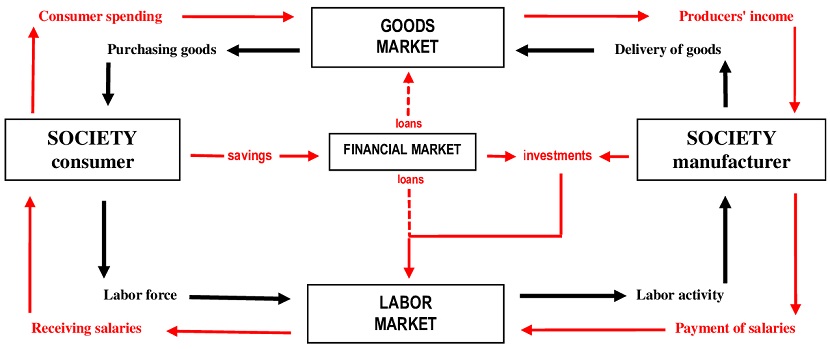
and money flows in the dynamics of expanded reproduction.
Source: created by the author.
The presented macroeconomic model of economic functioning illustrates a counter-synchronized circulation of labor inputs (both live and embodied) and monetary flows between producers and consumers, mediated by the goods and labor markets as well as the investment and credit functions of the financial market. The latter essentially acts as a credit-investment channel for redistributing monetary resources—withdrawn from current goods-money circulation — back into production.
The macroeconomic model requires clarification.
1. "Society manufacturers" and "Society consumers" are economic agents. Economic agents act simultaneously as manufacturers and consumers of material goods; however, they participate in production and enjoy the fruits of their collective labor in different capacities. They also channel investment capital into the economy in two primary ways: a) through the direct reinvestment of a portion of surplus value into their own production activities by entrepreneurs; and b) through the financial market from the income of entrepreneurs and citizens in the form of deposits, shares, bonds.
2. The "Goods market" and the "Labor market" constitute the goods-money exchange channels for the circulation of living and objectified labor. On the "labor market", living labor is potentially represented by the specific "commodity" known as labor power; on the "Goods market", objectified labor appears as a product — manufactured by living labor — in the form of a goods. The value of both goods (expressed in price) and labor power (expressed in wages) is determined by the same law of labor value governing the market economy. This implies that all exchange processes within the economic circulation of labor are driven by the requirement for value-equivalent compensation for labor inputs — a requirement realized through money, which sets in motion the circulation of living and objectified labor within the economy.
3. The "Financial market" comprises the banking sector and the stock market. The banking sector serves as a channel for lending to both "Society manufacturers" and "Society consumers". Loans to manufacturers flow through to the "Labor market", while loans to consumers flow through to the "Goods market". The stock market acts as a channel for the transfer of investment resources from "Society consumers" to "Society manufacturers". In this context, "Society manufacturers" perform a transit function by redirecting investment flows to the "Labor market" to further mobilize the workforce, thereby establishing the material and human resource prerequisites for expanded reproduction. Viewed in this light, the "Labor market" is more than merely an employment exchange, and the "Financial market" essentially performs the function of channeling labor resources to follow the investment flows.
How does a macroeconomic model function within the dynamics of expanded reproduction? Fundamentally, it operates much like the simple reproduction mode, yet it automatically triggers a specific endogenous process driven by the injection of funds — withdrawn from current goods-money circulation — into production. The result is twofold: on the one hand, excessive capital accumulation occurs; on the other, the direct channeling of financial flows into production for expansion — bypassing the goods market — causes effective demand to lag behind rising supply by an amount equal to the investment, ultimately slowing the pace of expanded reproduction. This type of process is characteristic of closed economies. In an open economy, however, it can be offset by increased exports and foreign investment.
Thus, withdrawing a portion of funds from goods-money circulation and redirecting them into production — despite the stimulus this provides — somewhat slows the macroeconomic cycle of living and objectified labor, condemning the economy to sluggish growth. However, the presence of bank lending distorts this linear development trend, creating a series of cyclical crises of commodity overproduction. The essence of this process is that bank credit — extended both to consumers to boost demand for goods and to entrepreneurs to renew working capital — replenishes the money supply withdrawn for reinvestment purposes. At the initial stage of a widening gap between production and consumption, this credit temporarily balances supply and demand, thereby postponing the economic crisis. The credit cycle then repeats itself. This continues until the rate of net entrepreneurial profit (after deducting bank interest) in the production sector falls, hypothetically, to "zero". Consumer demand, fueled by repeated rounds of borrowing, likewise shrinks toward "zero". Under these conditions, total debt eventually matches or even exceeds aggregate solvency, stalling the exchange of goods and plunging the economy into a massive crisis. Interestingly, however, capital accumulation does not disappear; it merely shifts from the production sector to the banking sector in the form of loan interest. In fact, this is not inherently negative, as during the subsequent economic upturn, the capital accumulated in the banking sector will flow back into the production sphere. This triggers a mass renewal of fixed capital, allowing the process of expanded reproduction to resume.
Question: Should state monetary policy — as conducted by the central bank — respond to the cyclical trend of economic growth by resorting to additional money issuance to stimulate consumer demand during a crisis of overproduction? Clearly not. For the intrinsic value of the money supply does not vanish during a classic recession (a time when money is "dear"). Having temporarily migrated to the banking sector, it enters a state of relative "hibernation". This monetary "slumber" — referring not to the banknotes themselves but to their underlying value — represents the preserved productive capacity of healthy businesses; these enterprises stand ready to resume operations the moment market demand emerges and investment capital flows back to them from the banking sector. Thus, monetary policy, while prioritizing the long-term stability of the currency, should maintain a measured approach to money issuance, regardless of cyclical fluctuations in economic development.
To summarize the key tenets of monetary theory:
a) Money serves as an instrument for the value-exchange processes involved in the circulation of living and objectified labor within a market economy;
b) The nominal value of money is determined by the real value of the mass of goods during the exchange of goods for monetary media within a single complete cycle of the circulation of living and objectified labor in the economy;
c) The total value of the money supply corresponds to the aggregate value of the volume of goods across the economy and grows in sync with the latter's growth rate;
d) To stabilize the monetary system under conditions of expanded reproduction, the state — represented by the Central Bank — must "zero out" the creeping revaluation of the monetary unit through a measured issuance of money that aligns with the long-term growth rate of the gross product, regardless of the cyclical nature of economic development.
The general conclusion is as follows: the economy is a self-regulating system that, by and large, does not require state intervention. The exception is a prudent monetary issuance policy by central banks, combined with the setting of key macroeconomic regulatory parameters — both monetary and fiscal — at optimal levels. This applies primarily to bank reserve requirements, the discount rate, and tax rates. However, implementing such macroeconomic policy in a globalized economy requires, at the very least, international coordination of actions — something that is quite problematic given the current conditions of disintegration and instability. Nevertheless, the theoretical development of the conceptual foundations for monetary system reform remains a relevant task.
World currency unit GES
Keynes, J.A. (1923). Tract on Monetary Reform. Gutenberg. URL: https://www.gutenberg.org/files/65278/65278-h/65278-h.htm
Cashin, P., McDermott, J. (2001). The Long-Run Behavior of Commodity Prices: Small Trends and Big Variability. IMF Working Paper. 2001. 28 p. URL: https://www.imf.org/external/pubs/ft/wp/2001/wp0168.pdf
Makhynko, V., Makhynko, L. (2017). Bread consumption norms in different countries of the world in terms of meeting the body's needs. Dspace. URL: https://dspace.nuft.edu.ua/server/api/core/bitstreams/40acb755-7022-4cc4-bd02-895046b497d8/content
Hawkesford, M.J., Araus, J.L., Park, R., Calderini, D., Miralles, D., Shen, T., Zhang, J., Parry M.А.J. (2013). Prospects of doubling global wheat yields. Food and energy security. №2(1). Р. 34–48. Figure 1: Progress in world average yields for major cereal crop yields. Data from FAOSTAT. Wiley Online Library. 2013. Mar 12. https://doi.org/10.1002/fes3.15
Special Drawing Rights (SDR). International Monetary Fund. URL: https://www.imf.org/ru/about/factsheets/sheets/2023/special-drawing-rights-sdr
Agarwal S. Currency in Circulation: How Much Money Exists in the World? India macroeconomic Indices. 2025. Aug 18. URL: https://indiamacroindicators.co.in/resources/blogs/currency-in-circulation-how-much-money-exists-in-the-world
World GDP Growth Rate. Macrotrends. 2025. URL: https://www.macrotrends.net/global-metrics/countries/wld/world/gdp-growth-rate
Per capita consumption of wheat flour in the U.S. 2000––2024. Statista. 2025. Nov 28. URL: https://www.statista.com/statistics/184084/per-capita-consumption-of-wheat-flour-in-the-us-since-2000/
Bread and bakery consumption volume per capita in Europe 2018-2030, by product type. Statista. 2025. URL: https://www.statista.com/statistics/806333/europe-bread-and-bakery-production-volume-by-category/
Are geo-politics constraining food? Grain market daily. AHDB. 2021. Oct 08. URL: https://ahdb.org.uk/news/are-geo-politics-constraining-food-grain-market-daily
USDA forecast big stocks on the horizon: Grain Market Daily. AHDB. 2020. May 13. URL: https://ahdb.org.uk/news/usda-forecast-big-stocks-on-the-horizon-grain-market-daily
World grain and oilseed supply and demand v ending stocks 1960 to 2012. Source USDA. MoffittsFarm. 2019. Nov 11. URL: https://www.moffittsfarm.com.au/2013/08/21/world-food-production-and-outlook/world-grain-and-oilseed-supply-and-demand-v-ending-stocks-1960-to-2012-source-usda-via-anz-813/
World Food and Oil Price Correlation. DeepResource. 2012. Аpr 26. URL: https://deepresource.wordpress.com/2012/04/26/world-food-and-oil-price-correlation/
Grain,_Oil,_Population. Figure: Grain, Oil and Population 1985 to 2007. Energyskeptic. 2013. URL: https://energyskeptic.com/2013/oil-production-fueled-population-growth-and-food-production/grain_oil_population/
Worldwide production of grain in 2024/25, by type (in million metric tons). Statista. 2025. URL: https://www.statista.com/statistics/263977/world-grain-production-by-type/
Overview of the OECD-FAO Agricultural Outlook 2016––2025. Figure 1.16: Long-term price of wheat in real terms. OECDiLibrary. 2015. URL: https://www.oecd.org/en/publications/oecd-fao-agricultural-outlook-2016_agr_outlook-2016-en.html
Overview of the Agricultural Outlook 2017––2026. OECDiLibrary. 2016. URL: https://www.oecd.org/en/publications/oecd-fao-agricultural-outlook-2017-2026_agr_outlook-2017-en.html
Real agricultural prices have fallen since 1900, even as world population growth accelerated. ErsUSDA. 2012. Nov 07. URL: https://ers.usda.gov/data-products/charts-of-note/chart-detail?chartId=76174